
Dolphins exhibit unique sensory capabilities with several features achieving performance exceeding that of humans.
As part of a larger study of the overall neural system of vertebrates (Chordata), the author has prepared several point studies on the sensory capabilities of the bottlenose dolphin, Tursiops truncatus.These studies have matured to the point where they can be shared with a wider audience.
A poorly documented feature of the bottlenose dolphin is its ability to change its facial conformation to suit its needs. When swimming fast, its facial conformation is hydrodynamically ideal. However, when it is attempting to examine one or more objects in detail, it can change the orientation of both its eyes and its ears as shown in the following markup of a figure from Caldwell & Caldwell.
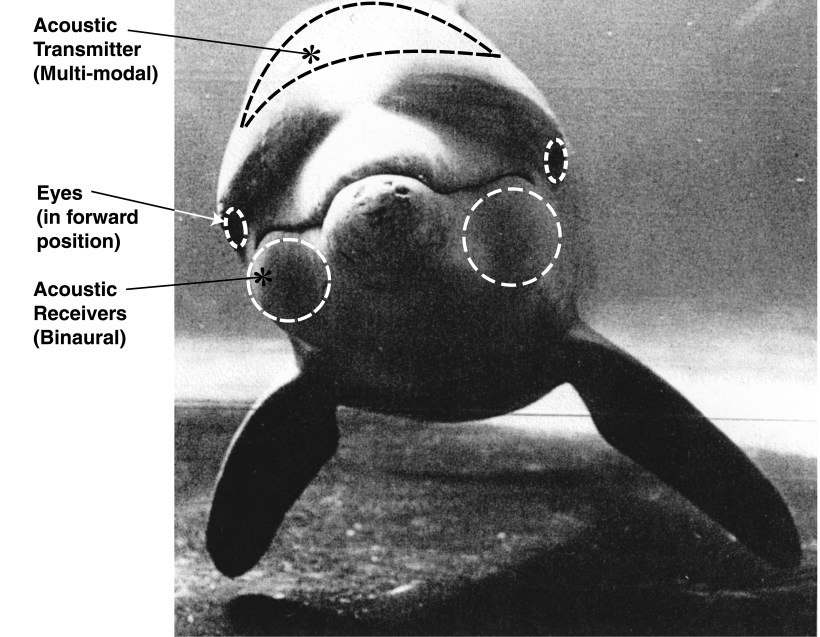
The prominent bulges to the left and right of the lower jaw are the "lens type" ears of this species. The acoustic lenses are formed of fatty tissue connecting directly to the inner ear. Both the "horn type" outer ears on the sides of the head and the middle ears are unused and have atrophied in this species.
The figure shows the bottlenose dolphin is quite capable of seeing straight ahead using its uniquely shaped eyeballs and flexible eye socket. [The eyes may be easier to see when the picture is printed on paper.] See also this profile view Estimates are the eyes share a 20-30 degree forward field of view. This value is similar to the acoustic field of view provided by the acoustic transmitter formed within the melon of its forehead.
There are strong indications that the echolocation capability of the bottlenose dolphin provides an imaging capability equivalent in angular resolution to the imaging capability of its eyes (which lack foveola). In murky water, the bottlenose depends on its acoustic capabilities much more than its eyes.
Continuing academic and field activities have provided strong support for the assumption that dolphins communicate using a sophisticated language that includes dialects for tribes of dolphins living in different estuaries and ocean sites for millions of years. Additional field work using recording techniques with bandwidths up to 40 kiloHertz are needed to provide the first decoding of this language.
Currently the studies include:
The vocalizations of the bottlenose dolphin have been studied by field biologists since the Ancient Greek period. While their ability and mimicry and even two-way communications using vocalizations have not been disputed, whether such communications constituted "language" has been disputed. The word "language" is a difficult one in English. As a noun, it is a label for one or more human languages, and more recently a suite of "machine languages." As an adjective, it is used by linguists to describe a communications faculty, better described as a language protocol.
To be described as a dolphin language, the dolphin must have the physical capability to generate a large variety of sounds (a symbol set) under cognitive control and employing a language protocol with at least the elements of a human language. Chomsky et al. have asserted that lacking a recursive semantic capability separates an animal communication system from a true language. To highlight his assertion, he describes the human recursive capability using the term infinite recursion. However, it is quite clear that a speaker using recursion beyond the third order will force the vast majority of human listeners to revert to pencil and paper to figure out what the speaker meant. The ability of bottlenose dolphins to employ recursive semantics (at least in human/dolphin interspecies communications have been demonstrated. The very strong implication is that dolphins could use the same recursive form in their own intraspecies communications if there was a need. Therefore, the Chomsky et al. assertion relative to recursion is not well founded. The largely academic challenge for humans is to determine the actual symbol set used in dolphin communications and then decrypt those communications through the application of Information Theory and conventional decryption procedures at both the phoneme (individual sound) and morpheme (syllable or word) level.
An interesting feature of dolphin physiology is the duplication of many of the features of the vocalization mechanisms. Because of this duplication, it is possible that the dolphin employes vocalizations in its language that are beyond the human capability. It is also possible that many of the features of dolphin language are shared with those called "throat singers" among the tribes of central asia.
A complete discussion of the language capabilities and a preliminary plan to decrypt this language of the bottlenose dolphin is available as an Appendix U, Dolphin_language.pdf to "Processess in Biological Hearing".
This page is in beta release. The author welcomes and will respond to any comments or suggestions left at the comment page. Section numbers of the main manuscript, available on the web, are shown in brackets. The manuscript can provide more detail when desired. The first number shown is the chapter number; it is followed by the section numbers. Download individual VISION chapters or Download individual HEARING chapters
1Caldwell, D. & Caldwell, M. (1972) The World of the Bottlenosed Dolphin. NY: J. B. Lippincott pg 108
2