The site presents a genealogy of the Scots-Irish Fultons of North America who emigrated initially from their homeland of Ful-tounland Renfrewshire, Scotland to Beith, Ayrshire, Scotland and then to the Lagan River valley of County Antrim, Northern Ireland before immigrating, essentially enmass to other parts of the then British Empire, and specifically North America.
It is the natural instinct of anyone to understand their origins, and specifically the origins of their surname. The presence of the North American Inventor, Robert (Steamboat) Fulton (1765-1815) in elementary schoolbooks obviously heightens this interest among young Fultons. They invariably want to know if they are descendents of him. The author of this analysis is precisely one of these people. From the age of three, I wanted to be an engineer, "not someone who drove the trains, but someone who built the trains." In my career, I more than satisfied my wildest dreams in that area, during the golden years of the aerospace industry. Now, I have the time to achieve a lifelong goal, to search my genealogical relationship, if any, with Robert (Steamboat) Fulton. I can also share the results with you, if you have a similar interest.
Recently, I stumbled upon the website, Ancestry.com-after largely ignoring their television advertising. It is a phenomenal genealogical resource that has only become feasible in the age of the computer. They have arranged to have endless numbers of documents scanned into electronic form. This makes them readily available to any desk-bound genealogist. While less numerous than later documents, they offer a significant number of 16th and 17th Century documents related to Europe, and specifically the British Isles. As a result, I have been able to assemble a Fulton family tree going back to at least the middle of the 16th Century quickly and with a minimum number of questionable relationships. The tree spans at least 13 generations reliably, and has clearly shown the relationship between myself, two other current genealogists with the surname Fulton and with Steamboat Fulton, the first! I say first because I made extensive profitable use of the designation "Steamboat Fulton" going through college. I am sure others have done the same.
The most difficult task was to bridge the Atlantic. A number of factors aided this bridging. The most interesting fact was that researchers in Ireland were trying to figure out what happened to a John Fulton who disappeared from the Lisburn area in the late 17th CenturyAmerica. Simultaneously, researchers in the USA were trying to figure out where a John Fulton living in southeastern colonial Pennsylvania came from. Making the connection between these two John Fultons led to many other connections between Lisburn Fultons who had suddenly disappeared from Ireland and Fultons residing along Octoraro Creek in present day Pennsylvania and Maryland, as well as in other areas along the eastern seabord of North America.
For those with access to Ancestry.com, my complete tree is currently available as "Fulton-McHugh Family Tree" based on my parents unmarried names. Portions of that tree will be presented below and a current "GEDCOM" file, with extension .ftm, will be found on this website and accessed below. The complete analysis is available here.
This webpage is organized as follows;
The surname Fulton has arisen spontaneously in a number of locations within the British Isles, based on two historical situations. The name arises either to describe the trade of a group of people or of the location of a group of people. The trade origin has to do with the expression in old English, Fugel, fugol, fugul--noun--a bird, a fowl; and the ending T n-- noun-- an enclosure. The geography origin has two potential sources in old English. The first is Ful or Full--a collection of water, sea or clouds (having to do with water). The second is f l, having to do with unconsecrated land near an Abbey. JT (Trevor) Fulton has discussed the details of these derivations in 20091. This author has provided an index to Trevor's book that many will find helpful2.
The surname Fulton has arisen repeatedly on a local basis to describe the tradesman who kept or raised foul. However, this designation has not proliferated in any obvious way.
One early appearance of the name, in the form foulton, is in the famous Doomsday Book of year 1088. It describes a community in the most Eastern Region of England along the North bank of the Thames River, "three miles SW by W of Harwich in the County of Essex." The name Foulton Hall is in use their today. A second appearance is more germain to this analysis involves the low lands to the West of Glasgow, Scotland on the way to the Estuary of the River Clyde. Currently, it contains the Glasgow airport because of its gentle topogarphy. The area has been known as Fultoun-land since the 1170's, according to the charters of the nearby Paisley Abbey. It retained that nomenclature up through at least the mid 1500's. Currently, East Fulton, West Fulton and Fulton Wood are political designations found in the area.
It is the use of the name, by immigrants from the area of Fultoun-land,Renfrewshire, Scotland, that has expanded world wide.
As noted by Trevor, a surname is not adopted by people living in an area. It is when they leave the area that they adopt a surname to designate their origin, James of Fultoun as an example. This occurred when the population of this area grew excessively and emigration began to the West into the regions known as Ayrshire and Renfrewshire, adjacent to the Irish Sea. As documented by Gillespie3, large numbers of people immigrated to these areas, many adopting the surname Fulton in the process.
A specific group of these immigrants from Fultoun-land occuppied an "estate" on the western edge of a village that came to be known as Beith, in Ayrshire, Scotland. The estate came to be known as Muirton House in the British tradition. The property was occuppied by John de Foulton before 1554. This property remained in the hands of that specific Fulton family for more than 100 years during the 16th Century. In the early 17th Century, this area also became crowded and a new opportunity to improve ones standard of living appeared due to political changes by the King, who was both King of England (James I) and Scotland (James VI).
In the colonial period, from about 1590 to 1609, the eastern coastal area of northern Ireland was opened to settlement by the King in an effort to dilute the native Catholic population with "Englishmen" and thereby stabilize his holding obtained by conquest. The immigration involved crossing the Firth of Clyde at the northern end of the Irish Sea. The distnace across the water is less than twenty miles. At least a portion of the family of Muirton House appears to have accepted this invitation and took up one or more leases in the Lagan Valley up a small river from the estuary known as the Lough of Belfast. The location is about seven miles inland from the current city of Belfast. The new Fulton inhabitants prospered and expanded rapidly throughout the 17th Century.
There were a series of wars between the native population and the Crown in this area during the stormy 17th Century of British history. This period included the rise and fall of Cromwell within England. These battles have continued intermittently up to the recent past, as this area is now the border area between Northern Ireland and the Irish Free Republic.
For a series of reasons, the urge to emigrate from northern Ireland became strong in the early 18th Century. As a result, nearly the entire family of what came to be known as the Fultons of Lisburn emigrated during the first half of the 18th Century. This emigration left the population of Fultons at less than 30% of its peak value; after nearly a century of normal growth into early to mid 19th Century.
The family immigrated throughout the British Empire. However, a major core group immigrated to North America prior to 1740. This website is dedicated to and focussed on that group.
As outlined above, a William Fulton, with a potential birth date of 1590 to 1600 and a defined date of death in 1638, chose to leave the family homestead, Muirton House, in Beith, Ayrshire, Scotland in the hands of his sister and her husband. He crossed the Firth of the Clyde (a distance of about twenty miles across the Irish Sea) and settled in the Lagan Valley about seven miles Southeast of the center of current day Belfast. By 1638, he had sired five sons and was firmly established on a property known as the Belsize Lease near the village of Derriaghy.
The family flourished during the last half of the 17th Century. It occuppied a series of homesteads (leases) in and around the area that would come to be known, and is known today, as the city of Lisburn. Other members of the family became influential members of the city, owning significant businesses and groups of row houses as documented by Trevor. However, early in the 18th Century, a majority of the extended family, numbering about forty out of a total of about fifty, emigrated between 1720 and 1740. As documented by Sir Theodore Hope4 and Trevor, the various church and civil record offices nearly ceased to record activity related to this family. The trail of that portion of the family that went into the British Civil Service in India, Australia and New Zealand is documented in detail in Hope, and Trevor adds additional material related to his families activities in India. However, the trail of large portions of the family just grows cold. Hope's genealogical tables just grow blank in many areas, with the speculation that the people born in the valley may have emigrated.
While Trevor was documenting the disappearance of many Fultons from Ireland, Richar S. Fulton5 of Texas was documenting the sudden appearance of many Fultons in the New World, with a focus on those appearing around S. E. colonial Pennsylvania, and slightly later, central Pennsylvania aroung Lancaster, Harrisburg and York. The situation requires extra effort to document because the S. E. area was affected significantly by the imposition of the Mason-Dixon Line in 1767, that changed the political description of many of the relevant homesteads. Hoemsteads in the village of Rising Sun, Pennsylvania suddenly became located in or near Rising Sun, Maryland.
The purpose of this analysis was to match up the loose ends of the emigration from Lisburn with the loose ends associated with the S. E. colonial Pennsylvania area, and resolve any ancillary paths possible. The result is a study of about 60 pages labeled "The Early Scots-Irish Fultons of North America" with a focus on the strain migrating west to St Louis and Kansas City, Missouri at the end of the 19th Century.
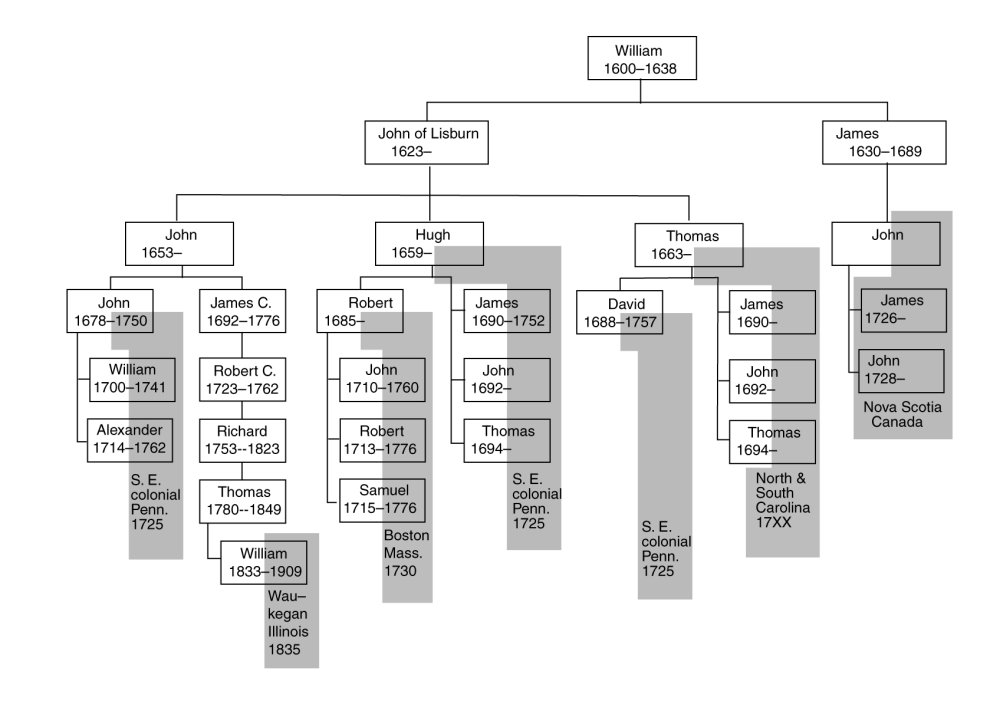
The following figure shows the simplified tree of William (1600-1638) and the ultimate destination of those members of the family who migrated to the "New World," with the exception of one member who migrated to Jamaica, where the line failed to propagate.
A peculiar situation has recently occurred on Ancestry.com. A romanticized event has become viral and appeared in a variety of family trees based on an incorrect reading of a historical fact.
A Lady Arabella, of the Stuarts of England, had married Edward Seymour clandestinely in 1610, in a cross-religious marriage not condoned by the King and considered prejudicial to his interests. As a result of an attempt to escape his jurisdiction, the couple attemtped to flee to France but She was caught. Lady Arabella was placed in the Tower of London, at the time a prison primarily for political prisoners of the King. The accommodations allowed live-in servants, etc.
After several years, and a period of declining health, the King was made aware of the situation and ordered a local cleric to attend to the Lady Arabella (only a few weeks before she died). The common thread relies upon a “minute of the Privy Council” of King James I of England, who was simultaneously King James VI of Scotland. It was dated 8 September, 1614.
A variant of this minute has appeared periodically in Burke’s “Landed Gentry of Great Britain and Ireland” beginning with the 1863 edition (240 years after the event). The specifics of the citation were changed dramatically in the 1912 edition and no longer refer to a Rev. Dr. Fulton.
Based on this bit of folklore in Burke's, the cleric was originally Reverend Dr. Fulton. This was later exapnded to Reverend Dr. Robert Fulton who was described as from Scotland and the father of William Fulton (1600-1638). The cleric is also frequently said to have married Lady Arabella (who was in the Tower because of her recent marriage to Seymour).
The available evidence is quite different. The first name of the Reverend Dr. Fulton was Nicholas and not Robert, and his last name was Felton, not Fulton. Nicholoas Felton (1556-1623) was born in Norfolk and not Scotland and he attended Queens College, Cambridge, not Edinburgh University. He was a cleric well known to the King as part of the team preparing the King James version of the Holy Bible. Reverend Dr. Nicholas Felton was in fact the Rector of the nearby St mary-le-bow church in London during 1596-1617. The parish of Mr. Dr. Felton’s church included the Tower of London. It remains so to this day. He was the obvious choice of cleric to attend to Lady Arabella.
It has been asserted that the cleric of the King's Minute retired to Lisburn due to his attachment to the Seymour family. This assertion is not supportable. The Seymour family did not acquire an interest in the lands around Lisburn until fity years after Mr. Dr. Felton's death. Mr. Dr. Felton in fact died in London and is buried in London. As his Cambridge biography states, he "Died Oct. 5, 1626. Buried in St Antholin's Church, London."
The assertion that Mr. Dr. Fulton was the father of William Fulton (1600–1638) of Derriaghy, is clearly spurious. Further detailed notes on this matter are attached.
The above figure shows the immigration of this family to North America occurred in waves beginning in 1725. The initial immigration to Nova Scotia was forced by the death of James (1630-1689) defending Londonderry, Ireland against the British Crown. His widow and two children emigrated within a few years. The son John is believed to have sired the two men James and John who fathered a large group of Canadian Fultons.
As Richard S. has shown, no Fultons appear on the tax roles of Chester County, Pennsylvania in 1722. However, they proliferate beginning in 1725 with the arrival of the family of Hugh (1659- ), probably accompanied by one of his nephews, David (1688-1757). Hugh appears on the tax roles in 1726, followed by his sons in 1730. This group was followed very quickly in 1725-28 by John (1678-1750) and his two sons. All of these people settled along the Octoraro Creek in S. E. colonial Pennsylvania as shown by the available tax roles.
In 1730, Robert (1685- ) and his sons immigrated to Boston, Massachusetts and eventually settled in Colerain, Massachusetts near Pittsfield in the Berkshire mountains. One of the members of this family is noted for having been a participant in the Boston Tea Party as a precursor the the Revolutionary War against King George III.
Later, a William (1833-1909), probably with his father, Thomas (1780-1849), mother and sister immigrated to New Your City. When grown, William moved on to Waukegan, Illinois and sired a large prominent family in that city. His father and sister appear to have returned to Lisburn, possibly after the death of the mother.
How exactly the Fultons traveled to Pennsylvania is not known. Ships were not required to submit passenger lists in those days, and there was no customs inspection, since the USA was still a part of the British Empire at that time. They probably embarked at Waterford, in the south of Ireland, a major oceanic sailing port in that day. It is likely they crossed the ocean aboard a schooner under sail and then traveled by coastal sailing ship from either Boston or New York to the Chesapeake Bay, although travel directly to Baltimore cannot be ruled out. Ships sailed to Boston and New York on monthly schedules in the 18th Century. Travel from Ireland to the Deleware River was generally less frequent and less regular. However, there was a monthly freight service between the Delaware and Ireland during the 18th Century. This service may have carried passengers westbound, rather than sail totally in ballast. After reaching the Chesapeake Bay, they could have reached the Octoraro Creek by traveling up the lower Susquehanna River by small craft, canoe or raft. Immigrants did not bring many things with them in that day. The homesteads were available on very easy terms and the climate was quite reasonable. The following figure shows the geography.
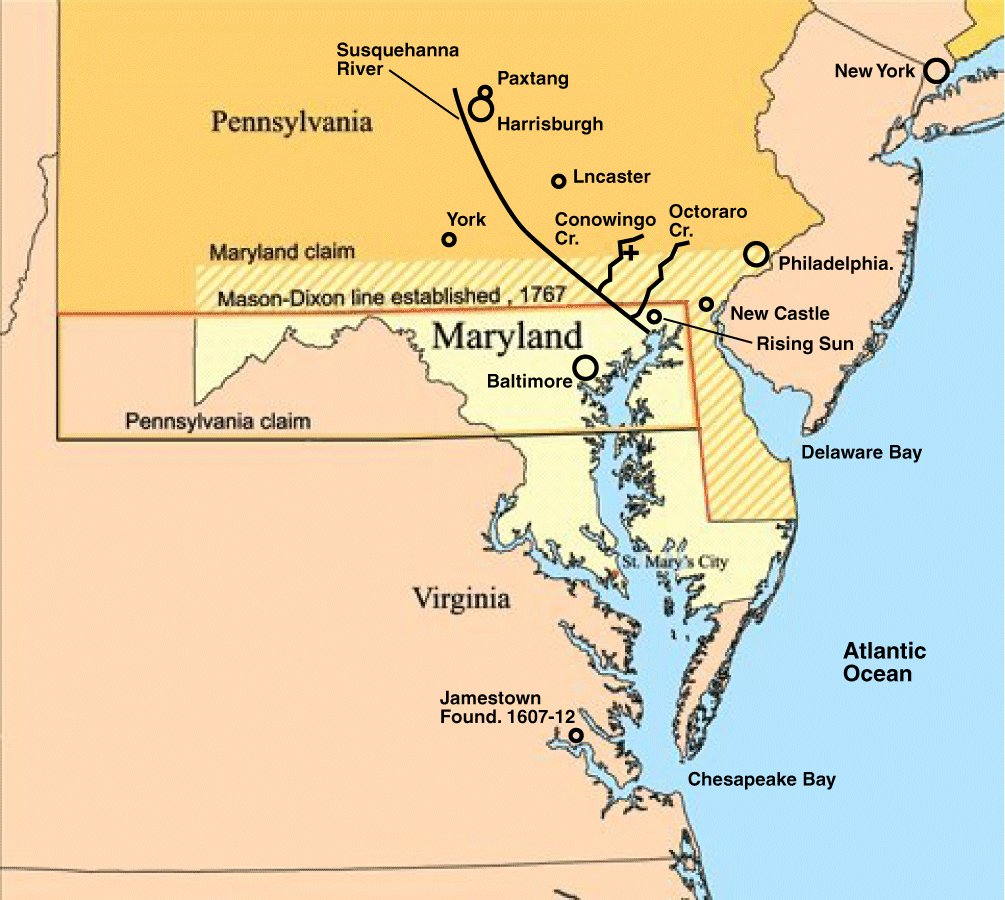
The Lisburn Fultons settled along both the upper and lower Octoraro Creek in what was generally known as Nottingham Township of Chester County, Pennsylvania. As noted earlier, the lower creek area was transferred to and became Nottingham County, Maryland in 1767. The Homestead of Steamboat Fulton was established some 40 years later along Conowingo Creek where the cross appears in what is now known as Little Britain Township. Overland travel was difficult through the virgin forests of this area at the time, and arrival via New Castle or Philadelphia would have been considerably more difficult. Another difficulty for the genealogists involves the fact, Octoraro Creek became the border between the original Chester County and the new Lancaster County broken off from it to the West. New Britain Township was formed much later in the new County of Lancaster. Many of the Fultons living along the west side of Octoraro Creek found their place of domicile relabeled in Lancaster County, rather than Chester County, Pennsylvania as time went on.
The grandfather of Steamboat Fulton, William (1700-1741) did not relocate directly to Little Britain Township. He first moved to the city of Lancaster Pennsylvania for many years. He did remove to the Little Britain homestead in about 1728 where Steamboats father, Robert I. Fulton was born in 1730. However, William failed as a farmer and moved back to Lancaster. Steamboat's father reacquired the property just in time for Steamboat's birth there in 1765. However, his father soon died and the farm was lost a second time. The property remained in private hands for many years until it was reconstituted as a museum, as it stands today along Conowingo Creek on Highway 222.
The family of William (1700-1741) failed to produce any male heirs after Steamboat's son Robert Barlow (1808-1841) who died childless. So, as frequently surmised in various documents, there are no direct male descendants of Steamboat Fulton. However, Steamboat's Uncle, Alexander (1714-1762) raised a large family in what became Rising Sun, Cecil County, Maryland. This family radiated out from Cecil County as shown in the following figure.
As a result, there are many Fultons in America who share a common ancestor with Steamboat Fulton, that ancestor is William Fulton (1700-1741), his grandfather.
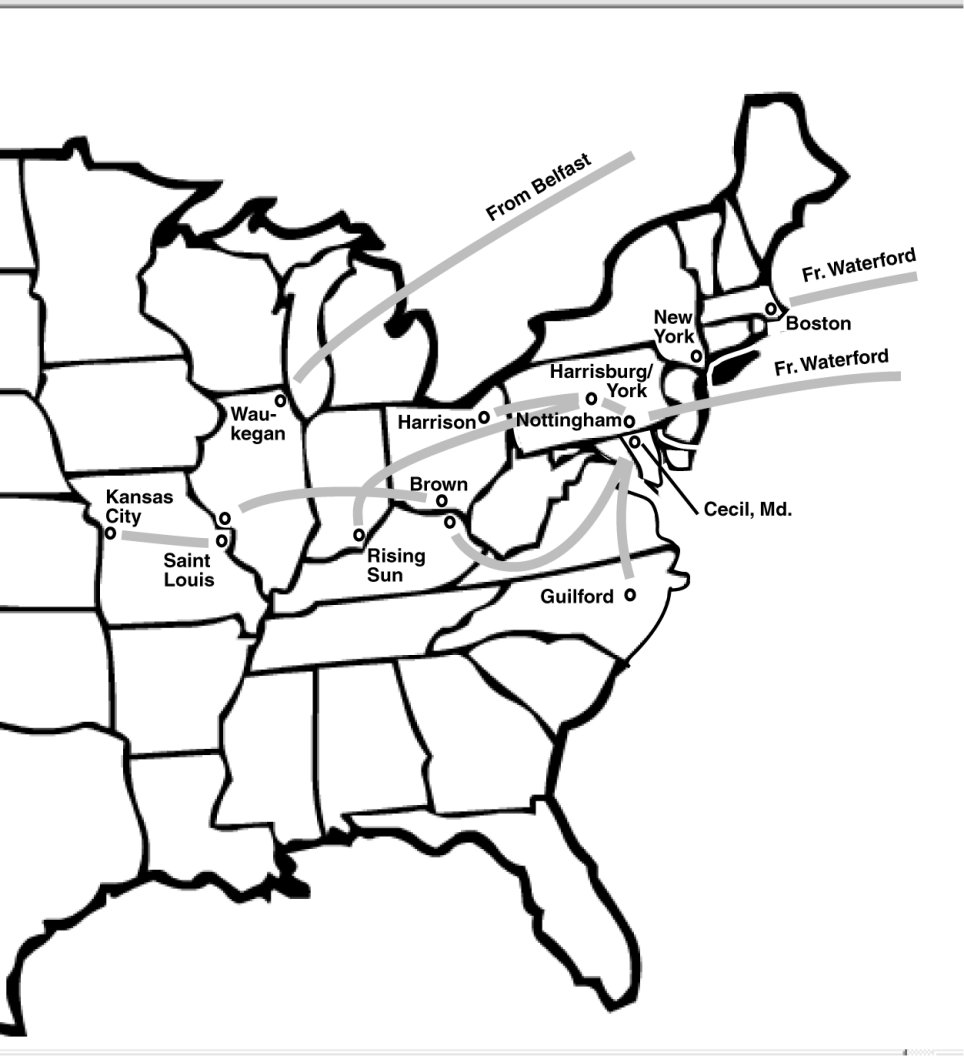
Three major radiations took place. A major group of several families move south into the area of Winston-Salem, North Carolina and flourished. A second family moved west to Brown County, Ohio where it flourished for at least two centuries. A third family moved up into the Lancaster, Pennsylvania area where it intermixed with a large number of Scottish immigrants in the mining and manufacturing areas of Pennsylvania.
Following the radiation of the Scots-Irish Lissburn Fultons from North Carolina and Lancaster Pennsylvania becomes quite difficult because of the intermarriage with Fultons who emigrated directly from Scotland. Tracing the Fultons from Brown County and from Waukegan, Illinois is considerably easier because of the lower density of Fultons in those areas in the 19th Century. The genealogist must be meticulous in tracing family lines in the former cases.
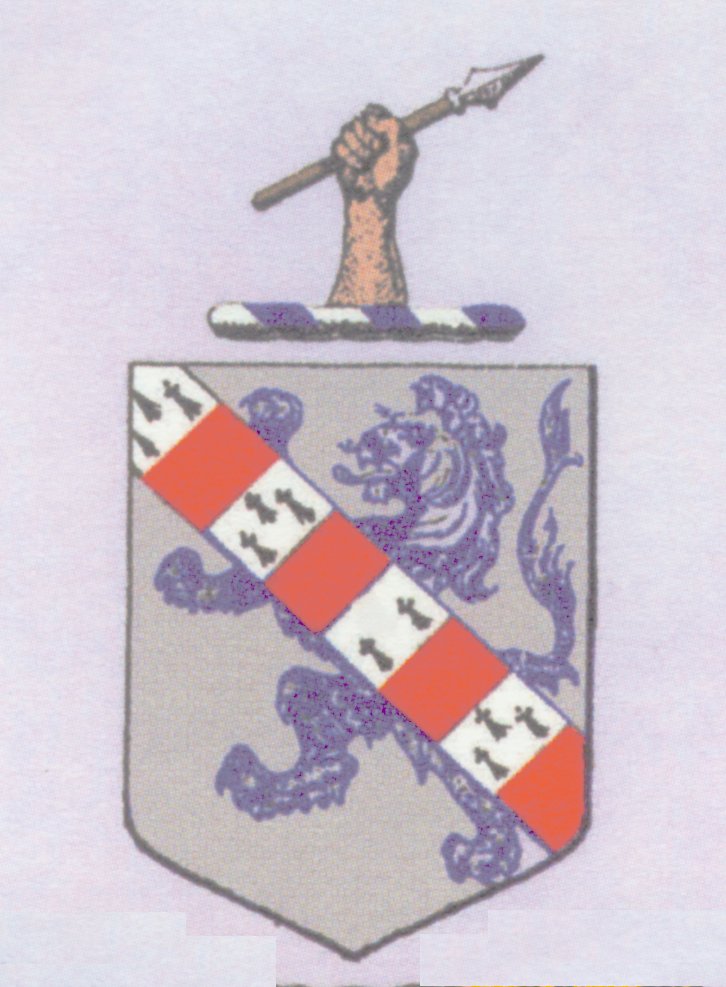
The shield on the Coat of Arms shows the prancing (rampant) lion, a symbol of ancient Scotland. The diagonal banner contains ermine and gules. An upright arm holds a broken javelin pointing to the left. Hope provided the following description of the Coat of Arms in the language of Scottish and Irish heraldry;
The Lisburn family have from an early date used a different crest and motto from that of the Ayrshire Fultons,—namel)-, a cubit arm erect grasping a broken javelin, point to the sinister all proper, with the motto, " Vi et Virtute." The family tradition, strong in the older members now passed away (as I well recollect), ascribed this to some incident in the career of Richard Fulton (probably 1650-1696), when a captain in the cavalry of William III., which led to his being granted or allowed to assume, the new crest and motto. No record of this, however, or of the reason for use of the English arms, can be traced. The earliest proof of use of crest and arms by the Lisburn f;unil\- is a ver}' old drawing, coloured, on ribbed paper, with the following written below : "The Sirname of P'ulton, an ancient P^amily, bear for .Arms, P^ield .Argent a Lion Rampant Azure over all a bend gabboned gules and ermine. Crest on a wreath of its colours a Naked arm holding in the hand a broken spear, all proper, motto, ' Vi et Virtute.' "
A copy of the complete Fulton-McHugh Family Tree has been prepared in two sections. The first section is a PDF file covering the first seven generations. The second section is a PDF covering the last seven generations. These files should be save as PDF files. These files can be opened in Illustrator, using a PDF reader, or similar graphics package that allows navigation about a large graphic. It cannot be viewed usefully in a simple "PaintShop" or "PhotoShop" type graphics program. The graphic is the equivalent of about six feet wide and three feet high when displayed in Illustrator.
A copy of the tree in GEDCOM format is also available for download. It can be opened in Family Tree Maker or other genealogical program that can read GEDCOM files.
The author welcomes and will respond to any comments or suggestions sent to his e-mail address, jtfulton@cox.net or via the Ancestry.com message service.
1 Fulton, JT (Trevor), 2009, "Fultons of the Lagan Valley in Ireland." Nicholson & Bass LTD and the , Ulster Historical Foundation.
2 Fulton, JT (Jim), 2011, "Fultons of the Lagan Valley INDEX." Click here
3 Gillespie,Raymond "Colonial Ulster: the settlement of East Ulster, 1600-1641" (1985) Cork University Press
4 Hope, Sir Theodore, 1903, "Memoirs of the Fultons of Lisburn" Self Published and available on the Internet at http://www.archive.org/details/memoirsoffultons00hope
5 Fulton, Richard S. website: www.richardsfulton.com (last updated 2006)
6